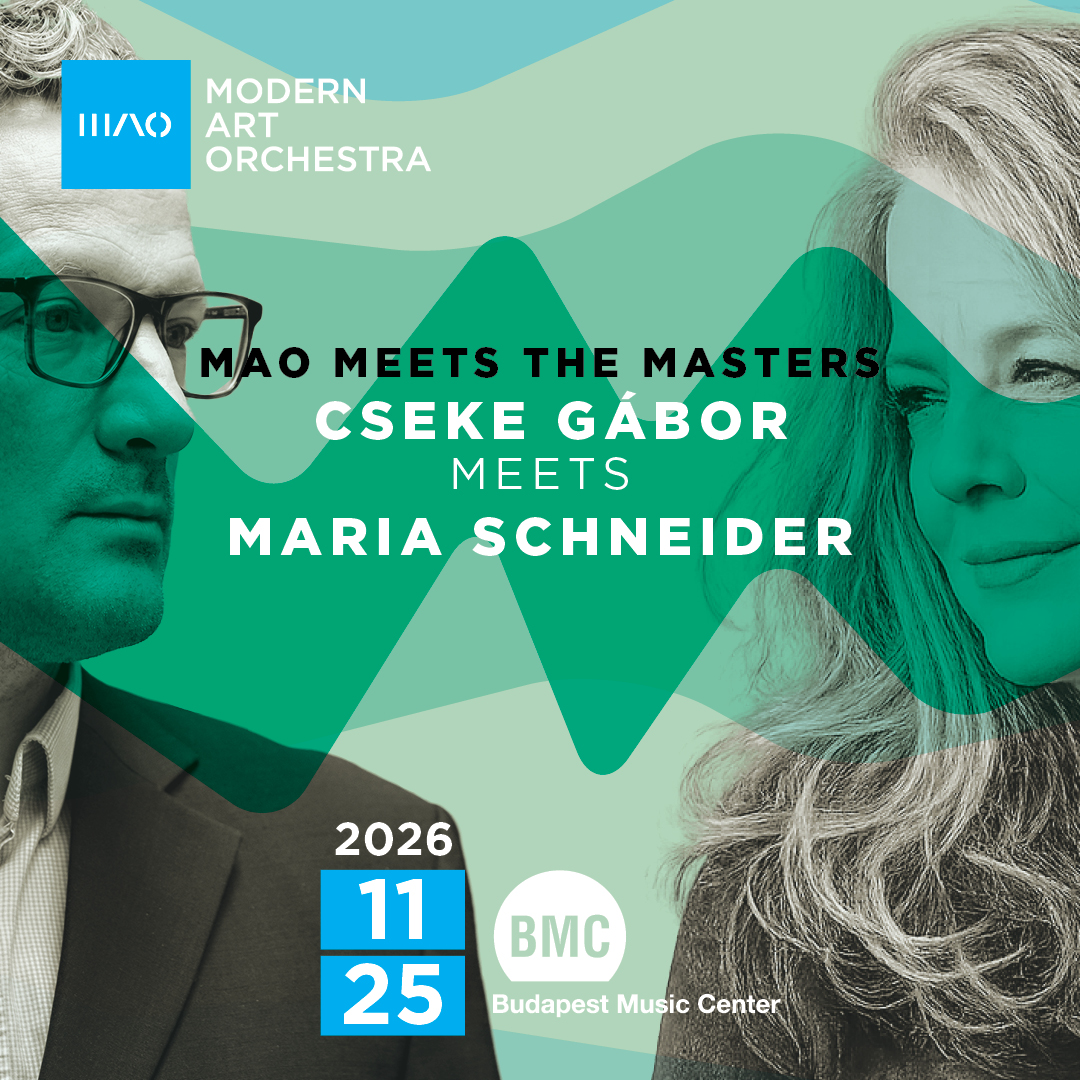
MAO meets the masters! – Cseke Gábor meets Maria Schneider, November 25, 2026
DIGITAL PROGRAMME · MAO MEETS THE MASTERS!

GÁBOR CSEKE
MEETS MARIA
SCHNEIDER

NOVEMBER 25, 2026 · 6:30 PM AND 9:00 PM
OPUS JAZZ CLUB · BUDAPEST, MÁTYÁS U. 8.

01 · THE EVENING

PAINTERLY COLOURS.
A PERSONAL ENCOUNTER.

How do the worlds of two composers meet through the sound of a large ensemble? In the MAO meets the masters! series, composers closely associated with the orchestra enter into dialogue with the music of a master who has shaped their thinking. Tonight, compositions by Gábor Cseke and Maria Schneider are heard side by side.

In Schneider’s music, instrumental colours and subtle dynamic shading are just as important as melody. Cseke’s own pieces bring a personal perspective to this world, including the world premiere of a work written especially for this occasion.

The music is performed by the Modern Art Orchestra conducted by Kornél Fekete-Kovács. Gábor Cseke also takes his place at the piano.

↑ Back to top

A melody at the centre.
An entire orchestra in the details.

02 · TONIGHT’S PROGRAMME

SIX PIECES.
TWO COMPOSERS’ WORLDS.

  1. BluebirdMaria Schneider
  2. High Flying (On My Own)Composer and arranger: Gábor Cseke
  3. Földi léptek, égi hangokComposer and arranger: Gábor Cseke · WORLD PREMIERE
  4. Braided TogetherMaria Schneider
  5. Twins (Cloud Chaser)Composer and arranger: Gábor Cseke
↑ Back to top
03 · CLOSER TO THE MUSIC

WHAT TO
LISTEN FOR.

Stories behind the works and a few listening suggestions for the evening. The details of each live performance are shaped by the musicians on stage.

01 · Maria Schneider

Bluebird

The freedom of a bird’s-eye view

Bluebird was premiered in April 2016, following a joint commission from the Hopkins Center at Dartmouth College, the Flynn Center for the Performing Arts and the Center for the Performing Arts at Penn State University. It also appears on the second disc of the 2020 album Data Lords, which explores the natural world. Schneider’s own notes highlight intricate lines and harmonies, with independent voices blending across instrumental sections.

LISTENING SUGGESTIONListen to the lines behind the melody as they separate and then come together again in a single orchestral sound. Try following the accompanying colours as well as the main melody.
02 · Composer and arranger: Gábor Cseke

High Flying (On My Own)

In his own voice

Gábor Cseke’s composition provides a personal counterpoint to Maria Schneider’s works. With the composer also at the piano, we hear him both as a creator and as a member of the orchestra over the course of the evening.

LISTENING SUGGESTIONChoose a short melodic phrase and listen for its return in a different instrumental colour or with a different accompaniment. The exchanges between soloist and orchestra are also worth following.
03 · Maria Schneider

CQ CQ, Is Anybody There?

Is anyone on the air?

CQ, in the title, is the general call used by amateur radio operators. Schneider’s father was also a radio amateur, with the callsign W0ABF. A conversation with another amateur radio operator sparked the idea for the piece, which incorporates Morse code rhythms. Memories of personal connection meet questions about power, data and artificial intelligence in the digital world. The work appears on the first disc of Data Lords, devoted to the digital world.

LISTENING SUGGESTIONListen to the short rhythmic signals as though you were searching for messages within them. Notice how the tension shifts between dense passages and more spacious orchestral textures.
04 · Composer and arranger: Gábor Cseke

Földi léptek, égi hangok

World premiere

A new composition written for this evening.

“Földi léptek, égi hangok is an attempt at a quiet dialogue with those who are no longer with us, for our lives do not end at the boundary of the visible world. Every earthly movement, decision and creation of ours becomes vibration, becomes sound, and travels through an invisible channel to those who now walk in heaven. This music was born of the hope that what we experience down here finds an echo above — and that, through melodies, we can still remain connected with them.”

— Gábor Cseke (translated from Hungarian)

Gábor Cseke will share more about the work’s origins and other details in person at the concert.

05 · Maria Schneider

Braided Together

Interwoven lines

The piece originated as All Night in Gusty Winds, a setting of a poem by Ted Kooser that Schneider wrote for Dawn Upshaw and the Australian Chamber Orchestra. Braided Together is its instrumental reworking and appears on the second disc of Data Lords, which explores the natural world. Without the singing voice, the melody takes on a new instrumental life.

LISTENING SUGGESTIONListen to the melody’s breathing: where can you hear a phrase that could be sung? Look for moments when the accompanying lines weave into it almost imperceptibly.
06 · Composer and arranger: Gábor Cseke

Twins (Cloud Chaser)

The composer’s orchestral world

Twins (Cloud Chaser) is the third track on the Modern Art Orchestra’s 2019 album Beat in Space. The album centres on Gábor Cseke’s music; as the closing piece tonight, it brings his compositional world back into focus.

LISTENING SUGGESTIONNotice when the orchestra takes the initiative from the soloist and how it prepares new entrances. In a live performance, the musicians’ responses to one another can be just as compelling as the theme itself.
↑ Back to top
04 · COMPOSER · PIANIST

GÁBOR CSEKE

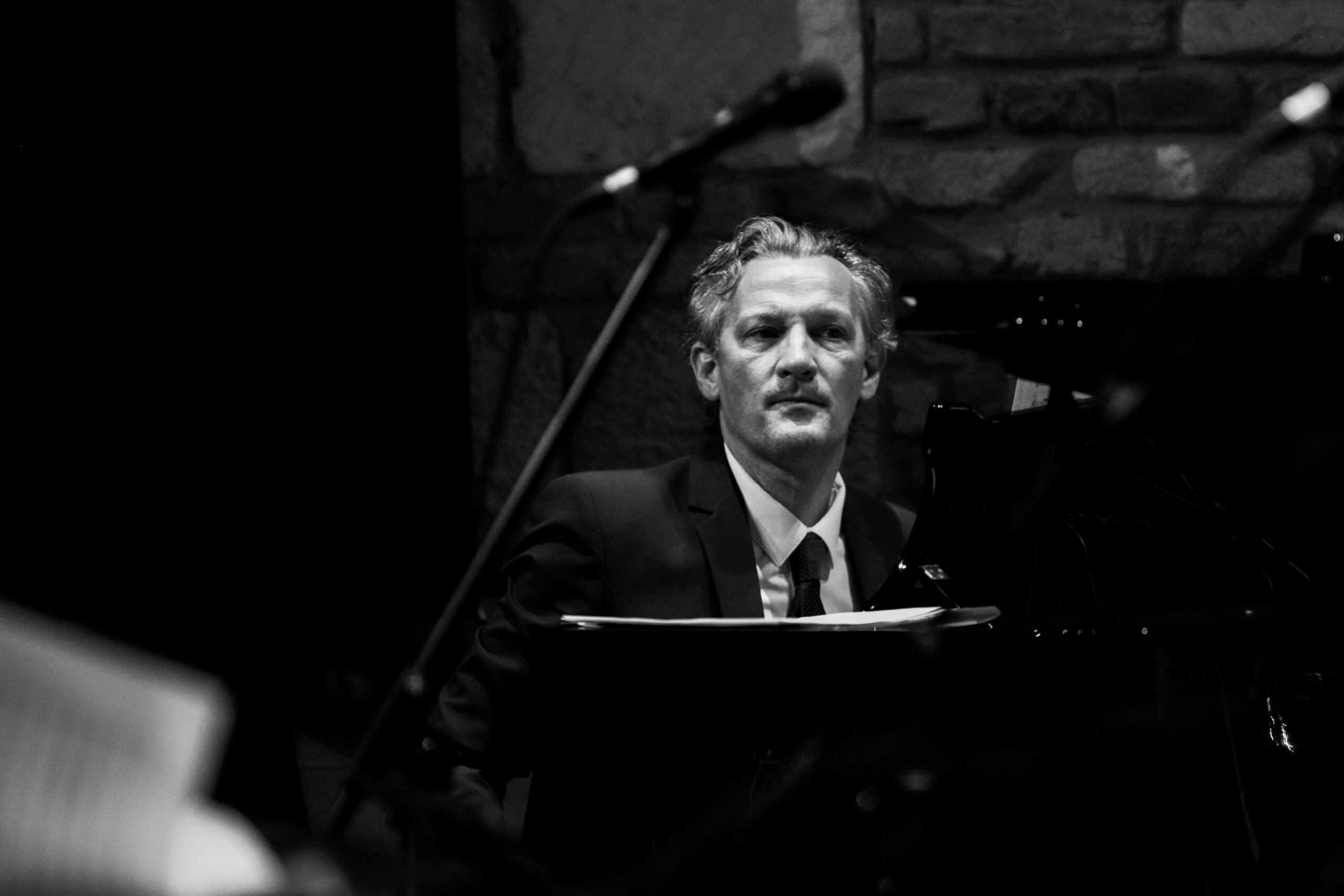
Gábor Cseke
Gábor Cseke · Modern Art Orchestra

Jazz pianist, arranger, composer and music educator Gábor Cseke was born in Pécs in 1971. He began his classical studies at the city’s Liszt Ferenc Music School, continued as a private student of Károly Binder, and was subsequently admitted to the jazz department of the Liszt Ferenc College of Music.

He is the Modern Art Orchestra’s pianist, arranger and composer. As a member of the orchestra, he has worked with international artists including Benny Golson, Johnny Griffin, Wallace Roney, Kurt Elling, Bob Mintzer, David Liebman, Randy Brecker, Chris Potter, Mike Garson, Tony Lakatos and Al Di Meola. A regular performer at Hungarian and international jazz festivals, he has appeared on more than a hundred recordings as a pianist, composer or arranger since 1998.

Teaching has accompanied his performing career throughout. Since 1997, he has taught at music schools and higher education institutions: after the Pomáz Music School and Kőbánya Music Studio, he taught in the jazz department of Kodolányi János University. Since 2021, he has been a faculty member at the Liszt Ferenc Academy of Music. Between 2003 and 2007, he was the regular piano accompanist and musical director of Bartók Radio’s jazz competitions.

He also works as a composer and arranger with the Orsi Kozma Quartet and the ensembles of Klára Hajdu, Négy Évszak and Éva Bolba. He received the eMeRTon Award in 2006 and the Artisjus Award in 2008.

↑ Back to top
05 · COMPOSER · BANDLEADER

MARIA SCHNEIDER

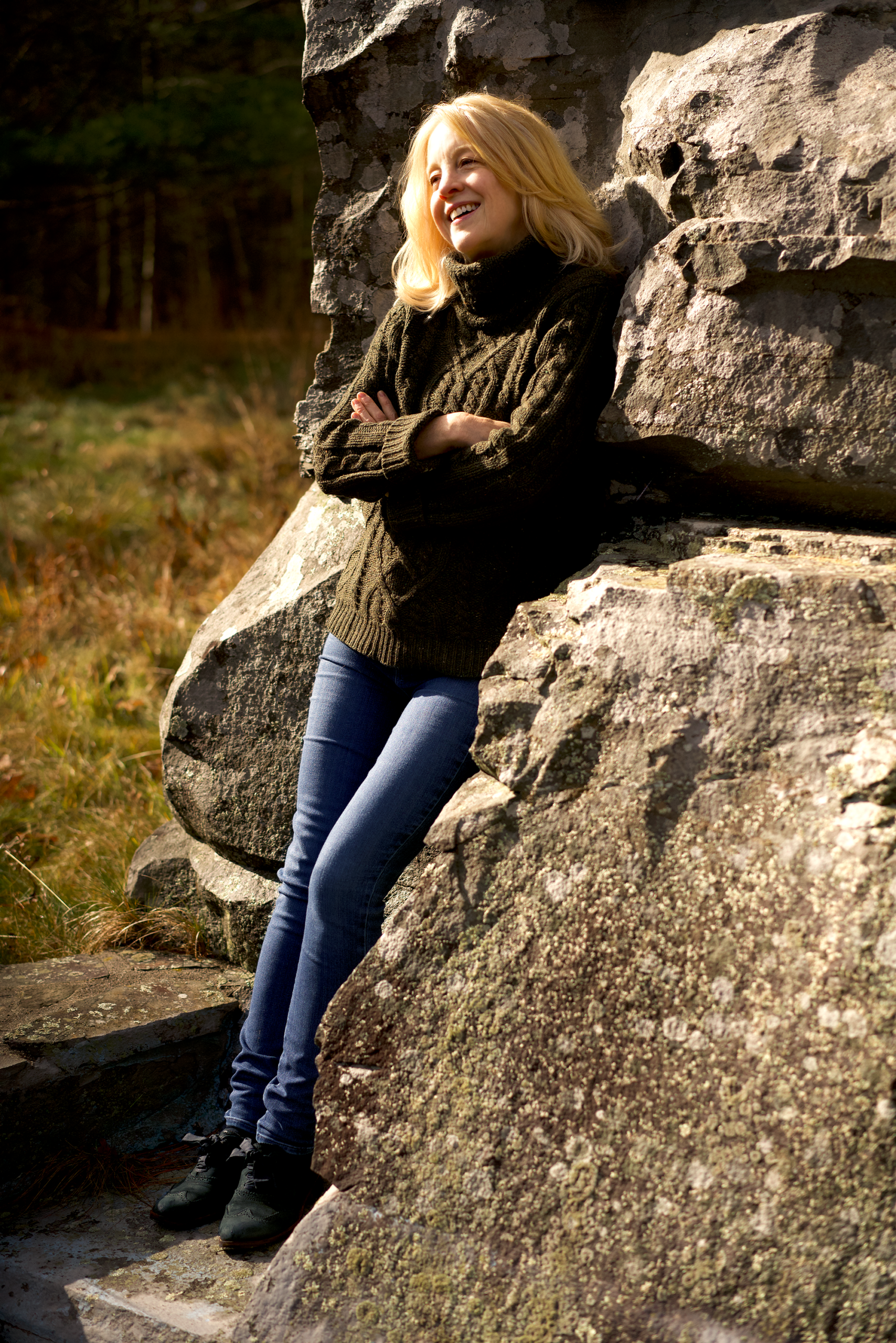
Portrait of Maria Schneider
Maria Schneider · Photo: Briene Lermitte

Maria Schneider is a leading composer and bandleader in contemporary large-ensemble jazz. Her music brings rich orchestration, subtle transitions and personal stories into a distinctive whole.

Data Lords is organised around two contrasting worlds: the digital environment and the natural world. Of the works heard tonight, CQ CQ, Is Anybody There? comes from the former, while Bluebird and Braided Together come from the latter.

Tonight offers an encounter with Schneider’s music, performed by the Modern Art Orchestra.

↑ Back to top
06 · PERSONNEL

THE MUSICIANS
BRINGING IT TO LIFE.

Conductor

Kornél Fekete-Kovács

Saxophones

Kristóf Bacsó
Árpád Dennert
János Ávéd
Balázs Cserta
Mihály Bajusznács

Trumpets

Balázs Szalóky
Gábor Hammer
Gábor Subicz
Gergely Bille

Horn

Hunor Varga

Trombones

Attila Korb
Mátyás Papp

Bass trombone

Miklós Csáthy

Tuba

Péter Kovács

Guitar

Áron Komjáti

Piano

Gábor Cseke

Double bass

József Barcza Horváth

Drums

László Csízi
↑ Back to top
07 · MODERN ART ORCHESTRA

A RECORD IS NOT
A MUSEUM PIECE.

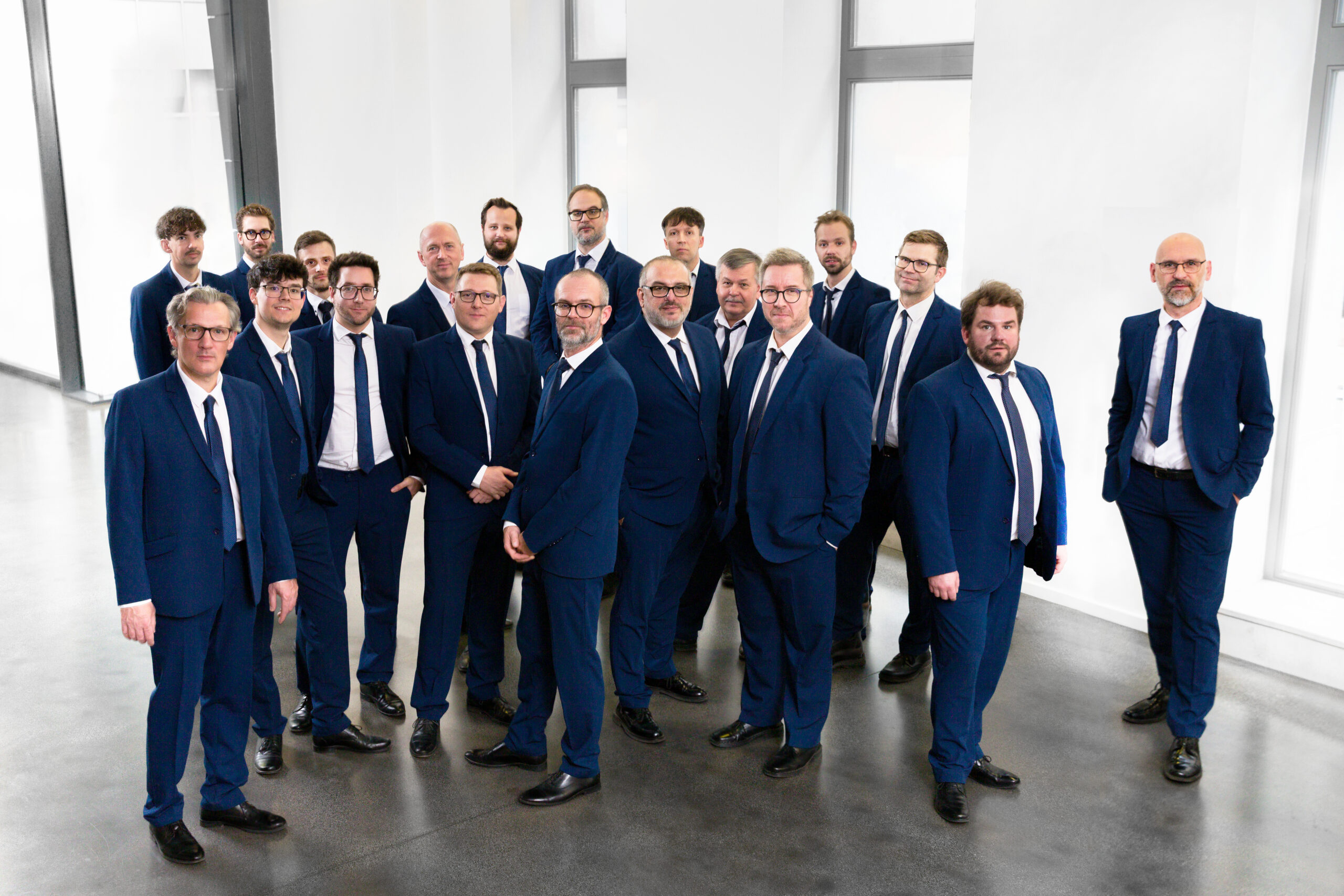
The Modern Art Orchestra’s story began in 2005 under the direction of Kornél Fekete-Kovács . Since then, more than twenty-five hours of large-ensemble music have been written specifically for the orchestra. That says a great deal about why, for MAO, the big band has never been a ready-made formula.

The orchestra is also a workshop: performers, composers and arrangers work together, often with the same person taking on all three roles. Jazz, contemporary classical music, electronics — here, boundaries are reference points rather than fences.

Seen in this light, the Legendary Albums series is no exercise in nostalgia either. Reproducing a 1958 recording note for note would be a curious undertaking: the original draws its power precisely from those musicians playing together in that studio, at that moment, responding to one another.

Sixty-eight years later, the more interesting question is what five musicians today will make of this music.

What remains untouched? What shifts? Where does the present make itself heard? The score may offer a starting point, but improvisation makes the answer a little different at every concert.

Perhaps this comes closest to the spirit of the original recordings: rather than preserving them, playing with them.

Modern Art Orchestra
MAO · SINCE 2005
AN ORCHESTRA, A COMPOSERS’ WORKSHOP
AND A CREATIVE COMMUNITY.
↑ Back to top
08 · COMING UP

LET’S MEET
AGAIN.

DECEMBER 1, 2026 · 8:00 PM · OPUS JAZZ CLUB

John Coltrane and Johnny Hartman

SOLD OUT · NO TICKETS AVAILABLE
↑ Back to top
09 · IF YOU ENJOYED THIS

LET’S MEET
AT THE NEXT ONE.

Concerts, new programmes, stories behind the music, the latest news — and sometimes things that simply won’t fit on a concert poster.

Subscribe to the MAO newsletter to hear about our next evenings in good time.

Modern Art Orchestra
Jazz and contemporary classical music ensemble
under the artistic direction of Kornél Fekete-Kovács.