

KENNY BURRELL
& JOHN COLTRANE
FIVE TUNES.
ONE AFTERNOON.
1958.
On March 7, 1958, Kenny Burrell, John Coltrane, Tommy Flanagan, Paul Chambers, and Jimmy Cobb walked into Rudy Van Gelder's studio in Hackensack. There was no long rehearsal process before the date.
Burrell later remembered it simply as a "blowing session." The musicians brought in a few tunes, ran through them once or twice, and then Van Gelder rolled tape.
You can hear the upside of that approach on the record. Five seasoned players, each listening for where the others are headed. Burrell often leaves the space to Coltrane, then with just a few notes steers the music back toward the blues.
There's room to breathe on this record. That's rarer than you'd think.
Tonight's concert opens with the album's five tunes. Then four more follow: Blue Train, Violets for Your Furs, Lonnie's Lament, and Time Was. That way, in a single evening, we get to drop in on several points along Coltrane's path.
BLUES × LYRICISM
NINE TUNES.
TWO CHAPTERS.
The first five tunes of the evening are the material from the Kenny Burrell & John Coltrane album.
Then we carry on with four more. Different eras, different characters – more stops on the same journey.
A FEW THINGS
WORTH LISTENING
FOR
Freight Trane
The tenor sax easily steals the show. Try following the guitar instead once in a while. It's interesting how much is going on in the background, even when it seems at first like the story is happening somewhere else.
I Never Knew
The head kicks off, and all is well. Then the improvisation slowly takes the wheel. Try to catch the moment when the original melody is more a memory than a road map.
Lyresto
Listen to the guitar's phrasing. There's something speech-like about it: a sentence, a comma, a pause. He doesn't feel the need to cram three more notes into every open space. It suits him well.
Why Was I Born?
On the original recording, the rhythm section drops out here. All that's left is tenor sax and guitar. Suddenly every small decision is audible: a breath, a held note, a silence half a second longer than you'd expect.
Big Paul
The longest tune on the original album. You don't have to say everything in three minutes. An idea can start, run its course, and give way to another. Notice how the energy shifts without anyone holding up a sign that says, "Next section starts now."
Blue Train
The head is firm, almost instantly memorable. Then the improvisation kicks in, and the space around it starts to stretch. Listen for how much fits inside one and the same frame that grows out of the blues.
Violets for Your Furs
If the first thing that comes to mind with Coltrane is dense, fast runs, this tune is a good counterexample. On a ballad, he handles time completely differently. Sometimes he holds a note longer than you'd expect. That's exactly what gives it weight.
Lonnie’s Lament
This is a later Coltrane. The head sounds simple, almost singable, while the music around it moves much more freely. A good point of comparison for where the evening started and how far Coltrane's thinking traveled in the meantime.
Time Was
The melody is a given. Everything else is an open question. Tempo, emphasis, phrasing, solos: the same composition can turn into a completely different animal depending on who gets their hands on it.
REHEARSAL?
SORT OF.
Rudy Van Gelder's name has become almost a character in its own right in the story of '50s and '60s jazz. He engineered the sound of countless records that we now consider classics.
In March 1958 he was still working in Hackensack, New Jersey. The studio was part of the family home. A surprisingly large share of jazz history was made in settings this un-cinematic.
Kenny Burrell & John Coltrane was recorded here too.
Kenny Burrell later recalled that it was a typical Prestige "blowing session." The musicians brought in a tune or two, ran through them once or twice, and then the tape was rolling.
They didn't much care, either, who the bandleader was on paper. They wanted to play. That was the whole point.
The record, oddly enough, didn't come out right away. The date was recorded in 1958, but the release titled Kenny Burrell & John Coltrane only reached the public years later.
FEWER NOTES.
MORE TO SAY.
There's strikingly little wasted motion in Kenny Burrell's playing. Clean melodic lines, precise entrances, turns of phrase straight out of the blues. If one note will do, he doesn't play five.
He grew up in Detroit, where the blues wasn't a style exercise but part of the city's musical mother tongue. Burrell later spoke about how the very simplicity of the blues form gives a player great freedom: with so little to hold on to, it quickly becomes clear whether you have something of your own to say.
That's a good listening key at tonight's concert too. The guitar often doesn't try to stand in the center of the music. It comps, responds, pulls back, and then with one short phrase suddenly changes the direction of the whole sentence.
Burrell later remembered Coltrane as one of the most focused musicians he ever worked with. He also said that when they played together, something special always happened.
COLTRANE IS
STILL EN ROUTE.
ALREADY COLTRANE.
NOT YET THAT
COLTRANE.
In 1958, John Coltrane is thirty-one years old. He's in one of the densest stretches of his career. He's playing in Miles Davis's band, he worked with Thelonious Monk not long before, and meanwhile recordings under his own name keep coming.
His sound is already unmistakable. The long, dense improvised lines are already there. The critic Ira Gitler had not long before dubbed this playing "sheets of sound": as if whole layers of notes were running through the changes all at once.
Meanwhile, we're still a long way from the world of A Love Supreme in 1964. And that's exactly what makes this period interesting.
You can hear a musician who has already found something, but is still searching for how far he can take it.
PERSONNEL
Tenor sax, guitar, piano, bass, and drums. The same five instruments that sounded on the 1958 recording.
A RECORD IS NOT
A MUSEUM PIECE.
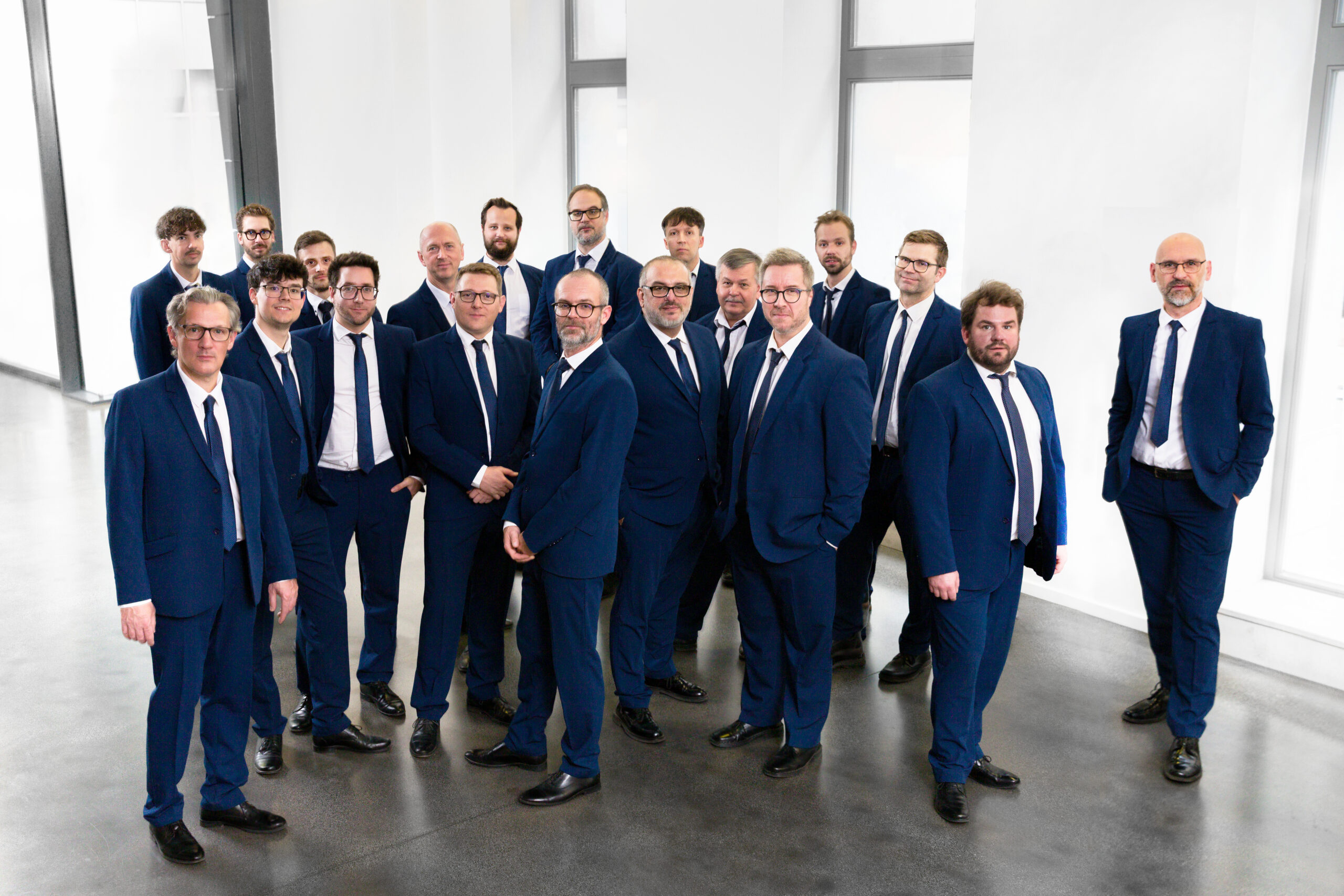
The Modern Art Orchestra's story began in 2005 under the leadership of Kornél Fekete-Kovács. Since then, more than twenty-five hours of large-ensemble music have been written specifically for the band. That says a lot about how, for MAO, the big band was never a ready-made recipe.
The orchestra is a workshop too: performers, composers, and arrangers work together, often with one person wearing all three hats. Jazz, contemporary classical music, electronics – here the boundaries are more like reference points than fences.
Seen from here, the Legendary Albums series isn't an exercise in nostalgia either. Reproducing a 1958 recording note for note would be strange anyway: the power of the original comes precisely from those musicians playing in that studio, at that moment, reacting to each other.
Sixty-eight years later, the far more interesting question is what five musicians today will do with this music.
What stays untouched? What shifts? Where does the present cut in? The score can offer something to hold on to, but because of the improvisation, the answer is a little different at every concert.
Maybe that's closest to the spirit of the original records, too. Not preserving them. Playing with them.
AND A CREATIVE COMMUNITY.
FOUR NIGHTS.
FOUR POINTS
ON ONE CAREER.
John Coltrane would have turned one hundred in 2026. The Modern Art Orchestra's fall series looks, through four albums, at how much his music changed in a relatively short span of time.
The first concert took us into the world of the early Coltrane. Tonight we hear him alongside Kenny Burrell. November brings the standards, and in December it's the turn of one of the quietest, most lyrical Coltrane records.
Same saxophonist. Four completely different nights.
8:00 PM
8:00 PM
SEE YOU AT
THE NEXT ONE.
Concerts, new programs, behind-the-scenes stories, fresh news – and sometimes things that simply don't fit on a concert poster.
If you'd like to hear about upcoming nights in good time, subscribe to the MAO newsletter.
A jazz and contemporary classical ensemble
under the artistic direction of Kornél Fekete-Kovács.